• Skip to primary navigation
  • Skip to main content
  • Skip to primary sidebar
  • Home
  • Privacy Policy
  • Help

Lake Holiday News

Everything you need to know about Lake Holiday ...

  • History
  • Videos
  • Sound Bites
  • Docs
  • Gallery
  • Silent Sitters
You are here: Home / Archives for 2008

Archives for 2008

The Law of Fraud

October 13, 2008 By LakeHolidayNews

Here’s a memo from LHCC’s former attorney, Steve Moriarty, to Howard Cihak, LHCC’s former GM. The topic: running water & sewer throughout Section 8A.

The plan then under discussion ran something like this:

  • convince lot owners to give their lots back to LHCC
  • LHCC runs water & sewer to all lots in the section
  • Selling the lots at “substantially higher prices”

The little wrinkle that would make this scheme work? Not candidly disclosing the plan to lot owners being asked to give their lots back to LHCC. As Moriarty himself said:

…[p]ublic disclosure of this plan would jeopardize its full potential.

The other complicating factor: the “buyer” would be represented by “directors who owe a fiduciary responsibility to the seller.”

In the end, Moriarty advised that it was a “brilliant way to take advantage of assets….” Are membership lot owners “assets” to be taken advantage of? Keeping in mind that LHCC was considering withholding utility extension plans from people it had a fiduciary obligation to serve and protect to get them to act against their own self interest, is it any wonder LHCC leaders were checking with their lawyer on the law of fraud?
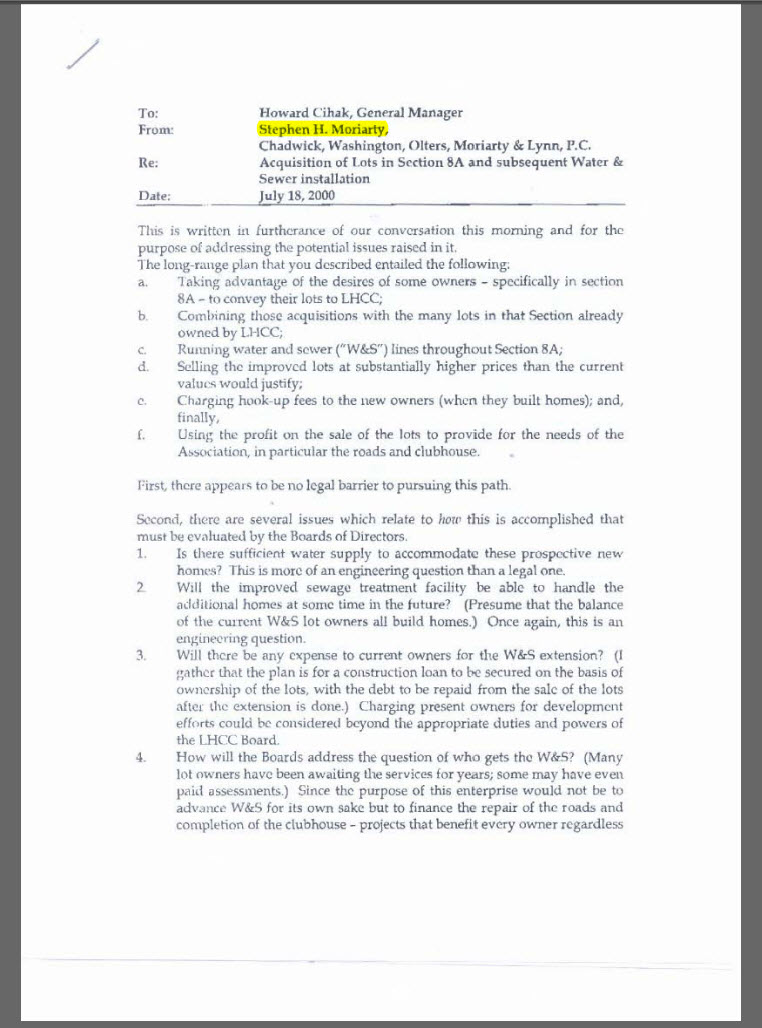
LHCC & the law of fraud

We’ve covered LHCC’s longstanding shabby treatment of membership lot owners. In June of 2007 Wayne Poyer wrote that LHCC was “very aware of the troublesome plight in which Membership Lot owners find themselves. It only makes sense that LHCC has such awareness of that plight, because the organization Poyer leads schemed for years to manufacture it.

With a history and leadership like this, is it any surprise the community is plagued by problems?

How informative did you find this post (1=lowest, 10=highest) ? Terrible2 Stars3 Stars4 StarsAverage6 Stars7 Stars8 Stars9 StarsTerrific!Loading...

Filed Under: Board Conduct, Membership Lots, Utilities Tagged With: Chadwick-Washington, Howard Cihak, Moriarty, Poyer

How Bill Masters Saved Lake Holiday $120,000

August 7, 2008 By LakeHolidayNews

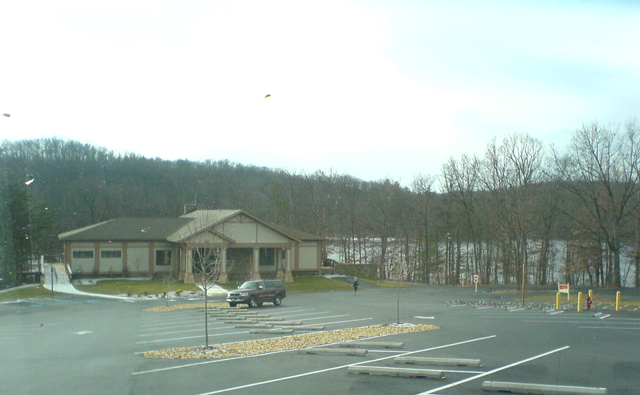
Clubhouse Post Renovation, January 2008
At the April board meeting, LHCC directors discussed a serious problem: they pledged the clubhouse (LHCC common area) as collateral for a loan from Wachovia without first obtaining owner consent. Several board members referred to this as a breach of their fiduciary duty, since common area can’t be mortgaged without first obtaining more than two-thirds consent of Lake Holiday’s owners and that consent was never obtained. GM Ray Sohl introduced the solution to this problem: “the board of directors has expressed an interest in re-collateralizing the existing clubhouse loan.”

The board’s solution: ask owners to retroactively approve mortgaging common area, and if approval were not obtained, to refinance the Wachovia loan at a great expense. Doing so would require paying about $18,000 in refinancing costs, paying approximately $20,000 more in annual debt service over 5 years, pledging 91 LHCC-owned lots, and allowing Wachovia to put a bank hold on $150,000 to $200,000 of LHCC’s cash. Add that up and you get a cash savings of $120,000.

That initial discussion of the problem was lengthy. Our nine video clips cover over an hour and ten minutes in Clubhouse Loan Pts 1-9:

YouTube player
«
Prev
1
/
1
Next
»
loading
play
Clubhouse Loan Pt 1
play
Clubhouse Loan Pt 2
play
Clubhouse Loan Pt 3
play
Clubhouse Loan Pt 4
play
Clubhouse Loan Pt 5
play
Clubhouse Loan Pt 6
play
Clubhouse Loan Pt 7
play
Clubhouse Loan Pt 8
play
Clubhouse Loan Pt 9
«
Prev
1
/
1
Next
»
loading

By July, preparations were underway to put the re-financing to an owner vote. LHCC announced the upcoming vote on July 21st. At the July 28th board meeting VP Dave Buermeyer, guided by Wayne Poyer, proposed the specific language to describe the issue to owners. Right away he met with resistance from 2 board members, John Martel and Jo-anne Barnard. Martel claimed that the language gave the refinancing proposal an “air of legitimacy that it probably never really achieved.” Then, Martel did an abrupt about-face and retreated from that position when Poyer seemed to be bothered by his remark. Jo-anne Barnard called the referendum “meaningless” because despite the high cost, the board had already decided to do the refinancing even if owners didn’t approve it. Nevertheless, every other director was satisfied with the decision to proceed with the refinancing. Many felt no further discussion was necessary.

YouTube player

Barnard and Martel felt the significant cost of the refinancing did merit further discussion. Barnard corrected the cost estimate served up by Poyer and Buermeyer. She observed:

It doesn’t cost $20,000. It costs $20,000 and $18,000 in the near term every year at the same time that we have to do the dam.

Here’s the July discussion in clips Oct 08 Referenda Pts 1-5:

YouTube player
«
Prev
1
/
1
Next
»
loading
play
Oct 08 Referenda Pt 1
play
Oct 08 Referenda Pt 2
play
Oct 08 Referenda Pt 3
play
Oct 08 Referenda Pt 4
play
Oct 08 Referenda Pt 5
«
Prev
1
/
1
Next
»
loading

So what’s the biggest problem in refinancing the clubhouse balloon note to fix pledging the clubhouse without first obtaining owner approval? The clubhouse isn’t even pledged as collateral on that note. Either Poyer and Buermeyer weren’t being candid about their reasons for proposing the refinancing or they never even bothered to check the documents. If they had taken just a moment to read the collateral exhibit, they would have seen that it clearly contains a description of real estate that is not the clubhouse.

A cautionary word to the non-lawyers that try to comprehend an important legal document like the loan collateral exhibit: it’s a whopping 2 pages, and the description of the property used as collateral involves potentially hard-to-understand legal terms, such as “231 Redland Road.” Proceed carefully!

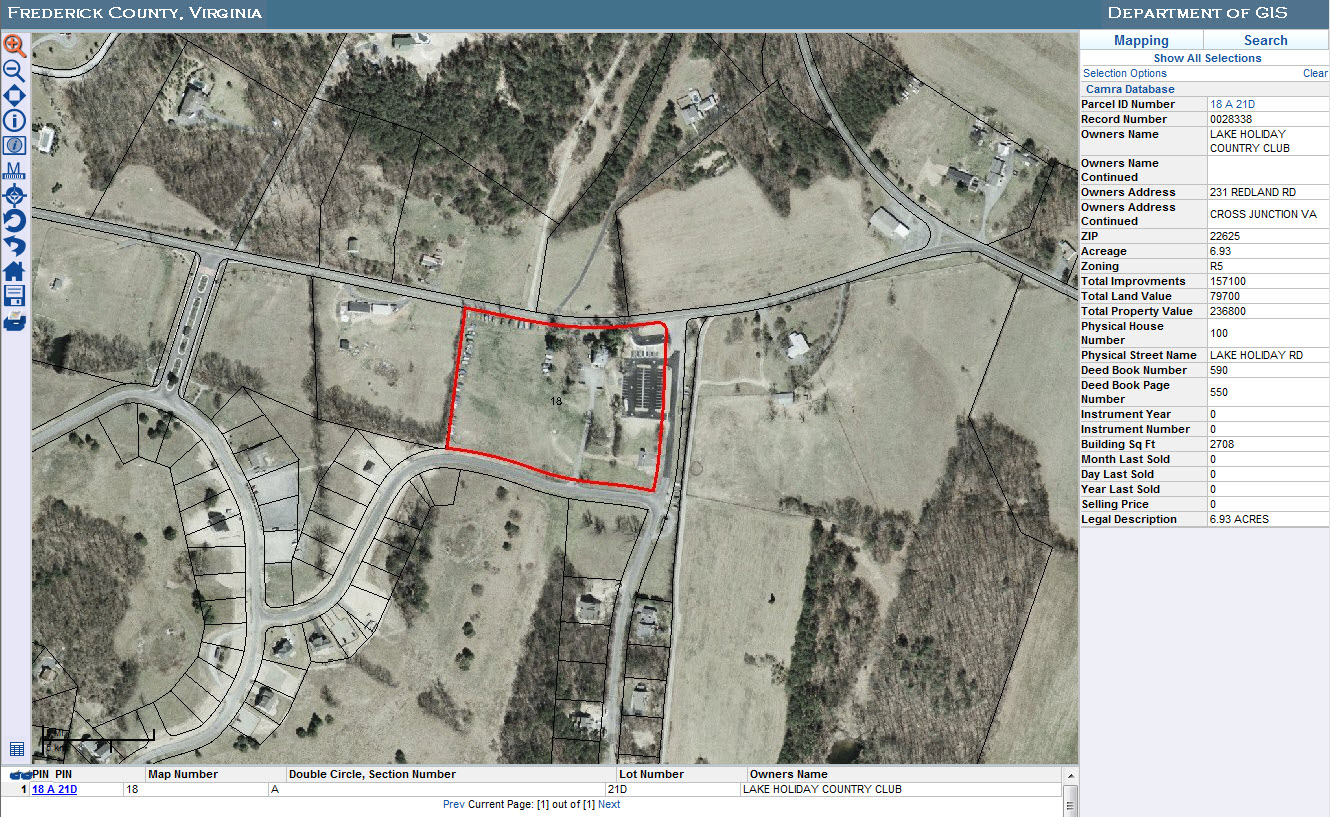
Frederick County Tax Map 18 A 21D
After watching the video of the July meeting, property owner Bill Masters did bother to check the documents, and the exhibit showing the collateral for the loan very clearly listed the collateral as 231 Redland Road, the location of Lake Holiday’s management office. Masters contacted GM Ray Sohl, and directors Barnard and Martel to understand how they missed this.

Sohl initially disputed Masters’ assessment and insisted the clubhouse was used as loan collateral. Masters had to show Sohl that the loan for which the clubhouse had been used as collateral was paid off and closed months ago. Keep in mind that Masters was making his argument to Sohl and several board members using documents he originally obtained from the Lake Holiday office in the first place.

Barnard and Martel were surprised by his claim but promised to investigate. To further support his contention, Masters supplied loan documents to Barnard and Martel and Frederick County tax maps, one of which appears nearby. In a few days, Sohl, Barnard, and Martel came to the same conclusion that Masters had: the clubhouse wasn’t pledged on the loan in the first place, so there’s no reason to spend all that money on the expensive refinancing supported by Poyer and Buermeyer.

The cash savings, as Barnard herself pointed out at the board meeting, is about $120,000 over 5 years. When Masters discussed with Barnard the significant cash savings, Barnard disputed her own number. Evidently, dollars that Masters saves don’t count as much as dollars that the board very nearly wasted. Beyond the cash savings, Lake Holiday retains clear title to its 91 lots and has unrestricted use of the $200,000 that it would have had to pledge to do the refinancing. Masters managed to accomplish all of this while holding down a full time job and not serving on the board.

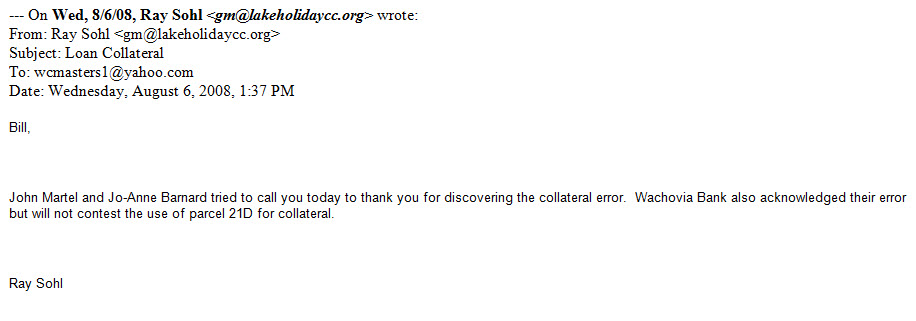
Ray Sohl to Bill Masters email 8/6/08

Barnard’s attempt to discount the savings is just evidence of the board’s spin machine revving up. More evidence of that is Sohl’s email to Masters, thanking him for catching the “error,” but pointing the finger at Wachovia for not securing the loan with the right collateral. Maybe Wachovia’s Mike Wilkerson has a different opinion of who owns the “error.”

Much can be learned from this episode to improve Lake Holiday. LHCC directors voted to spend over $120,000 of the organization’s cash based on the erroneous belief that the clubhouse was pledged as collateral, a belief that reading the loan documents would have quickly corrected. While Barnard and Martel were against spending money on refinancing, at a minimum they and every other director are guilty of approving a significant expenditure without bothering to read the underlying documents. That’s wrong. If any director did read the collateral documents and recommended the refinancing based on a claim that he knew to be false, that would be far more troubling.

When Masters first called Ray Sohl, he encountered far too much resistance. Sohl spent too much time defending the position that the clubhouse was pledged as collateral, perhaps because the board had already invested so much time to approve the refinancing. If the clubhouse were not pledged, it would make all the resources devoted to the refinancing an embarrassing waste. Fortunately, Masters took the time to make the phone calls and send the emails to overcome Sohl’s resistance. Masters was in an exceptional position because he had previously requested the relevant documents and closely followed the board videos, two things for which he is often unjustly criticized. But it shouldn’t be that hard for owners to get the management office to reach an obvious conclusion. While this went from start to finish in about 3 days, that was too long because the loan collateral exhibit was so clear and unambiguous. The initial response involved too much defensive posturing. If Masters had not persisted after receiving Sohl’s initial response, the savings may have been lost.

Fortunately, Masters saved $120,000 of Lake Holiday’s cash. What the community learns from this affair may be even more valuable.

How informative did you find this post (1=lowest, 10=highest) ? Terrible2 Stars3 Stars4 StarsAverage6 Stars7 Stars8 Stars9 StarsTerrific!Loading...

Filed Under: Board Conduct, Board Meeting, Finances Tagged With: Buermeyer, Jo-anne-Barnard, Martel, Masters, Mike-Sweeney, Murphy, Noel-OBrien, Pat-Shields, Poyer, Ray-Sohl, Robin-Pedlar, Suzy-Marcus, Wachovia

What Judge Prosser Asked Us To Do

June 30, 2008 By LakeHolidayNews

A short but interesting open forum kicked off the June 23rd meeting of LHCC’s board. The Bemis case was on a few minds. A woman named Pat, a member of the Alliance to Save Lake Holiday, encouraged owners to send out emails to support the passage of Sen. Jill Holtzman Vogel’s now tabled special interest legislation. Pat’s effort to support a side in the case was confusing to some audience members, because Pat, as a member of the Alliance, is on both sides. She, like every Alliance and Friends of Lake Holiday member, is both a defendant and a plaintiff.

Here are some excerpts of the discussion:

Property Owner: Which position are you supporting, the plaintiff or the defendant? Because from what I understand you’re both.

Alliance Member Pat: You’re asking who I’m with?

Property Owner: You’re telling us to go out and support “our” side. Ok, is it the plaintiffs’ side or the defendants’ side, because the way I understand it, most of the people here are on both sides.
…
Tom Wallace: You indicated that people are on both sides. There are people on both sides. We’re the defendants. The board is …

Property Owner: They have also cross-claimed as plaintiffs.

Tom Wallace: That doesn’t mean anything except…

Property Owner: It means that they’ve cross-claimed as plaintiffs so they’re on both sides.

Tom Wallace: Only a few of them.

Wayne Poyer: That has nothing to do with plaintiff, that’s a cross-claim. But you are technically correct. We don’t consider…I don’t think anybody who has made a cross-claim or counter-claim considers themselves part of the plaintiffs’ group.

Property Owner: Then why are they cross-claiming?

Wayne Poyer: Because that’s what Judge Prosser asked us to do.

Every member of the Alliance to Save Lake Holiday and every member of Friends of Lake Holiday has filed a cross-claim. That means every member of the Alliance and every member of Friends is a plaintiff against LHCC, the very organization they claim to be trying to save. The “Crossclaim against LHCC” for all Alliance members can be found buried on page 23 near the very end of their filing, and the cross-claim for all Friends members can be found in their pleading, “Cross Claim Against Defendant Lake Holiday Country Club Inc.” The cross-claims effectively repeat the arguments made by the original Bemis plaintiffs and make every party to the cross-claim a plaintiff.

These 2 groups include many former directors, every past president in recent memory, and every current director except Ken Murphy. In other words, in a case alleging that LHCC, run by its directors, has illegally collected assessments not authorized in the owners’ deeds, 10 of 11 current directors who are charged with collecting those assessments have adopted the position that LHCC has collected and is continuing to illegally collect assessments not authorized in the owners’ deeds. If that sounds ridiculous, it’s because it is.

Both current LHCC President Wayne Poyer and Tom Wallace, a former LHCC director, are members of the Friends group. When Wallace replied “only a few” in response to the comment about the position taken by current directors, he was wildly inaccurate. He also failed to mention that he himself is a plaintiff against LHCC. Was his distortion intentional? Or have pleadings been filed in his name that he doesn’t have knowledge of or agree with?

The exchange shown on the video triggered an email from a homeowner to Wayne Travell, the attorney representing the Bemis plaintiffs. The homeowner was troubled by Poyer’s statement that he did “what Judge Prosser asked him to do.”

This just didn’t seem right to me. I don’t know much about law, but it seems to me this is out of line.

Below is Travell’s reply:

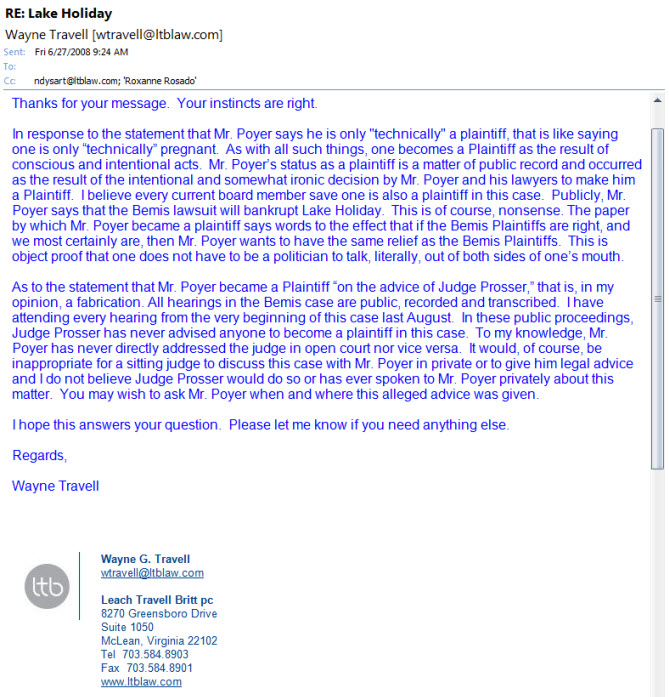
Wayne Travell to Troubled Homeowner 6/27/08

Travell responded that “Mr. Poyer has never directly addressed the judge in open court nor vice versa.” He added that he does not believe the judge has engaged nor would engage in private communications with Poyer.

Wayne Poyer openly told his own neighbors at a public meeting that the judge in an active case asked him to take a particular course of action. Poyer suggested his status as a plaintiff was just a technicality. Former director Tom Wallace didn’t candidly acknowledge he is a plaintiff and distorted that 10 of 11 current directors share that position with him. Even Alliance member Pat failed to mention that she is a plaintiff.

How can homeowners separate fact from fiction with leaders like these?

How informative did you find this post (1=lowest, 10=highest) ? Terrible2 Stars3 Stars4 StarsAverage6 Stars7 Stars8 Stars9 StarsTerrific!Loading...

Filed Under: Board Conduct Tagged With: Jill Holtzman Vogel, Poyer, Tom-Wallace, Travell

Jill Holtzman Vogel’s VA POA Act Amendment Is Tabled

June 27, 2008 By LakeHolidayNews

Sen. Jill Holtzman Vogel (R-27)
Sen. Jill Holtzman Vogel’s (R-27) emergency effort to amend Virginia’s Property Owners’ Association Act has been tabled for the special session still going on in Richmond. Her bill, SB6016 (our link is to a PDF redlined version of her bill provided to us by her office), Virginia Property Owners Association Act; reformation of declarations, was originally introduced in the Senate on Monday 6/23, where it was quickly referred to the Committee on General Laws and Technology. At a vote of that committee on Tuesday, the bill was reported out, or sent to the full senate. On Wednesday 6/25, the first vote on the measure in the full senate failed, but after a recess, a second attempt narrowly approved the measure by a single vote.

Following approval in the Senate, SB 6016 made its way to the House of Delegates, where it ended up in the Committee on General Laws. The next stop: the Housing Commission. And that’s where it stopped. Both we and others raised a number of concerns about the proposed legislation, perhaps the biggest of which was a serious question of constitutionality at the state and federal levels. The Housing Commission unanimously decided to table the bill for the remainder of this special session.

According to the Winchester Star, “Vogel repeatedly has stated that her bill is not related to an ongoing lawsuit against Lake Holiday Country Club Inc.” She continues to maintain this position. Bob Diamond, an attorney from Reed Smith representing Miller & Smith, and an attorney from Rees Broome, who happens to represent LHCC, were among the very few attendees commenting to the commission. Given their Tyson’s Corner offices are about 2 hours from Richmond, it’s an odd coincidence that attorneys for 2 defendants in a lawsuit happen to be about the only ones showing up to champion a bill that its chief senate patron said is “not related” to that lawsuit.

Start to nothing in 4 days. The legislative process is pretty quick in a special session.

We’ll discuss this further in due course.

How informative did you find this post (1=lowest, 10=highest) ? Terrible2 Stars3 Stars4 StarsAverage6 Stars7 Stars8 Stars9 StarsTerrific!Loading...

Filed Under: Board Conduct Tagged With: Bob Diamond, Jill Holtzman Vogel, Miller-&-Smith, Reed Smith, Rees-Broome

Jill Holtzman Vogel Rushes To Help Out Big Developer

June 22, 2008 By LakeHolidayNews

Virginia state senator Jill Holtzman Vogel (R-27) plans to introduce special interest legislation next week to amend Virginia’s Property Owners’ Association Act (POA Act) whose sole purpose is to affect the outcome of active litigation in Frederick County.

Vogel’s proposed legislation:

  • Was originally drafted by the attorneys for Miller & Smith, a big northern Virginia developer and one of the defendants in the lawsuit;
  • Is an attempt to get around 3 Virginia Supreme Court decisions over more than a decade;
  • Is inconsistent with well-settled Virginia property law and at odds with the state constitution; and
  • Will impact the property rights and values of owners in more than 9100 community associations throughout the state.

Vogel herself:

  • Is a public policy lawyer, and by her own admission to plaintiffs’ counsel, does not have the knowledge or experience to hastily tinker with property law;
  • Hasn’t had the time to fully evaluate the unintended consequences on property owners in more than 9100 community associations across the state;
  • Repeatedly masks her efforts as a small “fix” to a definition in the POA Act; and
  • Is trying to slip her legislation through in a very short special session of the legislature focused on transportation issues – a completely unrelated matter.

All that’s bad enough. What’s even more troubling is how she’s used the media to distort what’s behind her efforts and to distort how the plaintiffs regard her inappropriate meddling in active litigation.

A Timeline To Vogel’s Legislation to Bail-Out a Big Northern VA Developer
Date Event
1996-2007 Miller & Smith is a donor to Sen. Richard Saslaw (D-35).
? According to Vogel, Saslaw encourages her to undertake this project and offers the story that his personal doctor asked him to help out. She commits to him to introduce the legislation.
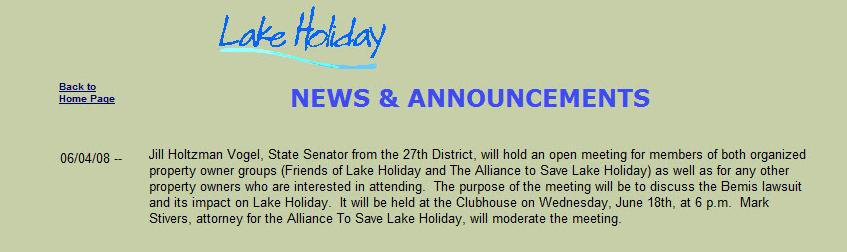
6/4/08 LHCC announces Vogel would hold an “open meeting” to “discuss the Bemis lawsuit and its impact”, moderated by local attorney Mark Stivers, counsel for a group of defendants.
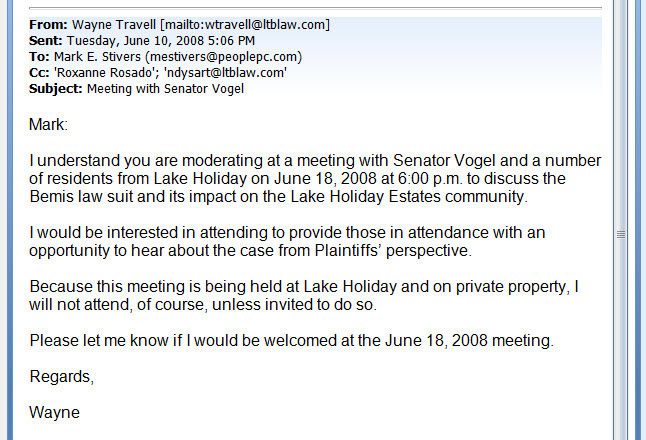
6/10/08 Wayne Travell, plaintiffs’ counsel, emails Mark Stivers and asks if he can attend.
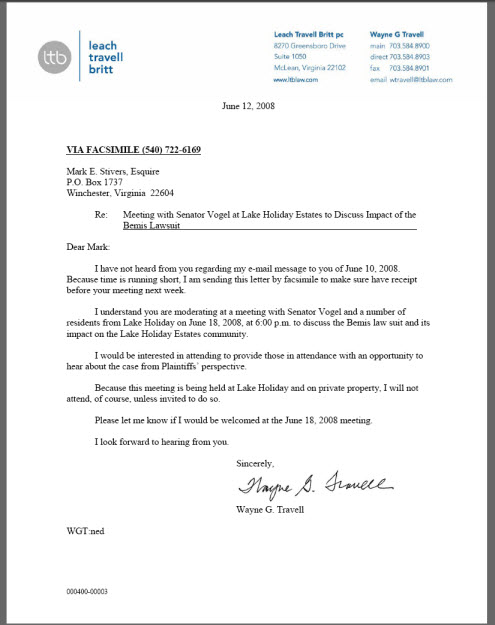
6/12/08 After getting no response from Stivers, Travell faxes him a letter.
6/16/08 Travell receives Stivers’ response. The reply: Travell is not welcome at Vogel’s allegedly “open meeting”, all of which is well documented.
6/18/08 Travell informs Vogel by telephone conversation and emailed letter that he’s being kept out of her “open meeting”.
6/18/08 4:39 pm Vogel provides Travell a copy of draft language she said had been written by lawyers at Reed Smith, counsel for Miller & Smith (a big northern Virginia developer).
6/18/08 6:00 pm Vogel holds her allegedly “open meeting” and, according to newspaper reports in both the Winchester Star and NV Daily, commits to introduce legislation at a meeting whose announced purpose was to be a moderated discussion. According to a property owner at the meeting, in response to a question on the appropriateness of her intervention, Vogel said that the Virginia Attorney General declined to assist her office, citing ongoing litigation.
6/19/08 10:30 am Vogel meets with plaintiffs’ counsel for the first time and acknowledges that she is not a real estate lawyer, did not understand the lawsuit and the POA Act, and that her first draft of the legislation was provided by lawyers for another party to the lawsuit. Plaintiffs’ counsel tell Vogel they are deeply troubled by her plan and urge her to stop.
6/20/08 Vogel tells the Winchester Star that the plaintiffs are “super-excited” by her efforts, despite repeated communications with plaintiffs’ counsel expressing they viewed her plans as inappropriate meddling in active litigation.

Let’s be absolutely clear. The plaintiffs are not “super-excited” by Jill Vogel’s efforts. They’re very troubled a sitting state senator would even contemplate introducing legislation drafted by 1 side of an active court case to attempt to re-write Virginia law in an area where she has acknowledged she lacks both experience and background, let alone publicly commit to doing so. She exposed her own lack of background when she described the POA Act as “almost 40 years old.” The POA Act was first enacted by the Virginia legislature in 1989, making it 19 – not almost 40 – years old. It’s a clear abuse of the legislative process when poorly informed legislators try to pass legislation to tip a pending court case that could, if enacted, end up having widespread, unintended consequences and upset well-settled Virginia law.

The Winchester Star reported Vogel said:

I don’t want to mess up what the plaintiffs otherwise want to gain.

That’s disingenuous nonsense. Wayne Travell, plaintiff’s counsel, in a face-to-face meeting, in phone conversations, and in multiple email messages unambiguously communicated to Vogel that the plaintiffs opposed her inappropriate intervention. After reading Saturday’s Winchester Star, Travell emailed Vogel to express that he was “shocked” at what he read. Of Vogel’s characterization of the plaintiffs’ position, Travell wrote:

Nothing could be further from the truth.

Vogel chose to interfere in an active court case. Her interference was prompted by the request of 1 side, not all sides, and was accompanied by strong and repeated requests by plaintiffs that she abandon her ill-advised plan. Those facts don’t square at all with her own statement that she is not trying to “mess up” the plaintiffs’ position in an active case. That is exactly what her legislation is all about: messing up 1 side for the benefit of the other, which just happens to be that of a big developer.

Vogel committed to proposing new legislation before even meeting with counsel for plaintiffs, so she could not possibly have understood what plaintiffs “want to gain” before deciding to intervene. She accepted draft legislation from the lawyers for 1 side. Despite learning before the allegedly “open meeting” that counsel for the plaintiffs would not be allowed to attend, she went ahead and held her meeting anyway. Later that same night, the lawyers that drafted her legislation called her to say that their own language wouldn’t solve their legal problems, so she’d have to come up with something else to fix their troubles. For a legislative session that starts on Monday, June 23rd, Vogel has been unable to provide a copy of her proposed legislation at this writing – late in the afternoon on the day before.

Local attorney Mark Stivers told the Winchester Star that he believes LHCC is a property owners’ association that falls under Virginia’s POA Act. If he really believes that, why is there so much effort spent to change the law? If the law is on your side, why do you need to change it?

Jill Holtzman Vogel is interfering because the law is clear and settled. And the big developer that Jill Holtzman Vogel has decided to help out doesn’t like that.

How informative did you find this post (1=lowest, 10=highest) ? Terrible2 Stars3 Stars4 StarsAverage6 Stars7 Stars8 Stars9 StarsTerrific!Loading...

Filed Under: Board Conduct Tagged With: Jill Holtzman Vogel, Mark Stivers, Travell

No Serious Discussion Tolerated

June 17, 2008 By LakeHolidayNews

The news according to LHCC: a meeting, open to any property owner, will be held on June 18th to discuss the impact of the Bemis lawsuit on Lake Holiday. Mark Stivers will “moderate” the discussion.

LHCC News Announcement of Vogel Meeting

A simple, polite request to offer an other perspective:

Travell to Stivers Email 06/10/08

With the simple request unanswered, a renewed request sent by fax:

Travell to Stivers Letter 06/12/08

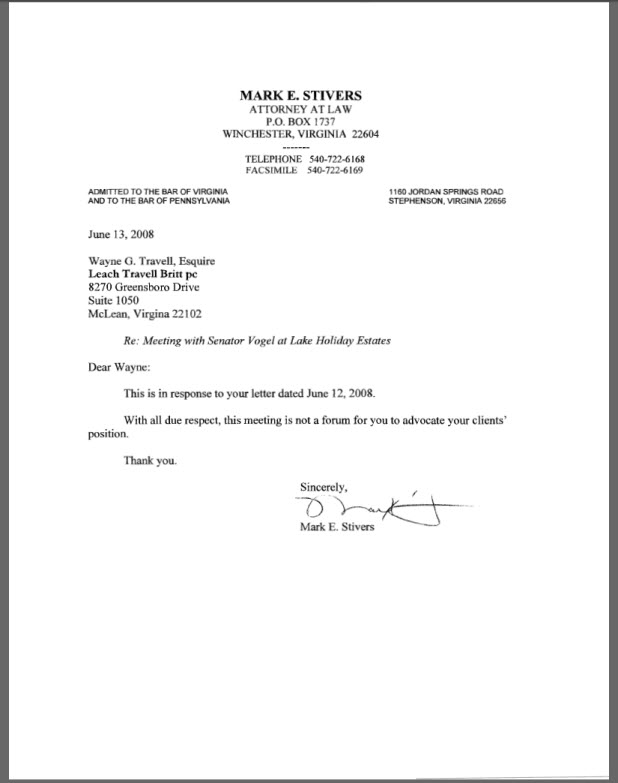
A terse reply, sent by regular mail:

Stivers to Travell Letter 06/13/08

The meeting is billed as a moderated, open discussion of the impact of the Bemis lawsuit. It will be just a one-sided, controlled series of speeches by Stivers and others to advocate their positions. When you have to lure people, including a state senator, to a meeting by promoting it as something it’s not and your views can’t withstand polite discussion, you’re on shaky ground.

How informative did you find this post (1=lowest, 10=highest) ? Terrible2 Stars3 Stars4 StarsAverage6 Stars7 Stars8 Stars9 StarsTerrific!Loading...

Filed Under: Board Conduct Tagged With: Jill Holtzman Vogel, Mark Stivers

This Has To Stop

June 15, 2008 By LakeHolidayNews

May 15, 2008 Budget Meeting
Whatever one may think of John Martel, he consistently manages to come up with great one-liners. Mind you, they’re not going to be heard on the big movie screen anytime soon. They’re just pithy observations on the problems at Lake Holiday. We took the title of this post from his remarks on the issue of ordering tote bags for new owners for the Welcoming Committee.

Too many bags were ordered at a price double what they should have cost because the wrong person ordered the bags.

Wayne Poyer described the mix-up:

A batch of bags was ordered which, based on the rate of people coming into the community, it’s going to last about 40 years.

As Martel said: “this has to stop, this has to stop.” We’ll go out on a limb and guess that the Welcoming Committee only welcomes new homeowners and not new membership lot owners with one of the too many totes ordered at an exorbitant cost.

YouTube player

The budget review was made a little more difficult when it was discovered that one of Mike Kilmer’s staff incorrectly coded an expense item as an income item. Robin Pedlar thought Kilmer’s firm was “overpaid.” According to Martel, the distribution of work between the LHCC office and Kilmer’s firm has created problems. His view:

It’s hard to sort out who’s doing what to whom.

Kilmer’s firm is paid $4250 per month (an annual rate of over $50,000), and the board was reviewing other cutbacks to balance the budget at the May 15th budget meeting. Despite that, Pat Shields didn’t think that meeting was the appropriate time to address the value of Kilmer’s services.

In the video of overpaying for too many tote bags, Robin Pedlar worried:

If this is indicative of how phony all the numbers could be, it scares me.

She was not alone in her concern about sloppy accounting. Wayne Poyer asked somewhat rhetorically:

How bad is our accounting?

Let’s look at one area, the relationship between delinquencies and receivables. In our videos 2008 1Q Delinquencies and How Bad Is Our Accounting, Treasurer John Martel gave the numbers on delinquencies: 114 homes (including trash assessments), 70 water/sewer lots, and 242 membership lots. Based on LHCC’s published assessment rates, this is a monthly delinquency of $30,748.08. Yet the difference between LHCC’s reported accounts receivable in March and April of 2008 is only $9,299.73. If the delinquency rate is actually that high, why didn’t accounts receivable go up by a larger amount? If it’s not that high, why is the board over-stating the delinquency rate and budgeting based on this over-statement? As Poyer himself remarked, the delinquency report “just doesn’t pass the nonsense test.”

Budget-related videos from this meeting also include a discussion of getting foreclosing banks to pay their dues and a brief review of Kilmer’s role (which includes a little spat between a frustrated Martel and Suzy Marcus). A few unrelated topics were addressed after the budget review: creating the nominating committee; handling road violations, in which directors acknowledged that the roving patrol is not authorized to stop alleged violators; and relisting lots for sale with Oakcrest.

YouTube player
«
Prev
1
/
1
Next
»
loading
play
Bank Foreclosures and Dues
play
Pedlar Says Kilmer Is Overpaid
play
2008 Nominating Committee
play
Road Violations Pt 1
play
Road Violations Pt 2
play
List Lots With Oakcrest
play
How Bad Is Our Accounting
play
2008 1Q Delinquencies
«
Prev
1
/
1
Next
»
loading

Steve Locke
If you find it odd that in all this budget talk, the name of Steve Locke doesn’t come up much, we do as well. Steve’s resume says he’s a certified financial planner and a former member of the Financial Management Task Force. He had little to say about changes to the budget, a topic that is very relevant to his background and experience. What is the point of serving on the board if you don’t have much to say on the topic most directly related to your background or work experience? Congratulations, Steve. You’re our Silent Sitter for the May budget meeting.

Suzy Marcus, 4/28/08 Winner
With all of the excitement about accounting and budgets (a subject that caused Robin Pedlar to comment a little past the half-way point of the budget meeting that “we’ve got to move faster or I’m going home”), we realized that we neglected to announce our Silent Sitter winner for the April 28th meeting. The most important topic covered at the April 28th meeting was a proposal to refinance the clubhouse balloon note. In a meeting where directors openly acknowledged they breached their fiduciary responsibility, Suzy Marcus sat in almost total silence. She neither objected to the characterization expressed by several board members that the board (of which she was a member) had in fact breached its fiduciary responsibility or raised any concern about the cost to fix that mistake. Important issues require the input of all board members. Congratulations, Suzy. You’re our Silent Sitter for the April meeting.

How informative did you find this post (1=lowest, 10=highest) ? Terrible2 Stars3 Stars4 StarsAverage6 Stars7 Stars8 Stars9 StarsTerrific!Loading...

Filed Under: Board Conduct, Board Meeting, Finances, Silent Sitter Tagged With: Kilmer, Locke, Martel, Pat-Shields, Poyer, Robin-Pedlar, Suzy-Marcus

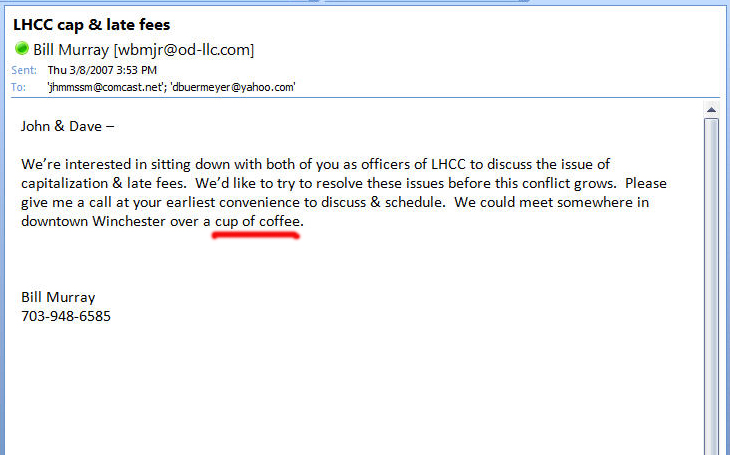
A Cup of Coffee

May 21, 2008 By LakeHolidayNews

A question. Were you, John Martel, ever asked to meet over a cup of coffee?

John Martel’s answer: “That’s not true.”

From March 8, 2007. Let’s have a cup of coffee.

Murray to Martel Email 3/08/07

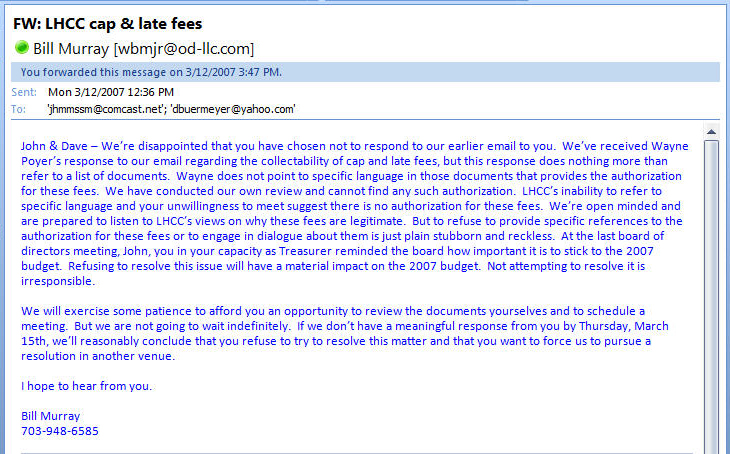
A tickler 4 days later, after no response from Martel or Buermeyer.

Murray to Martel Email 3/12/07

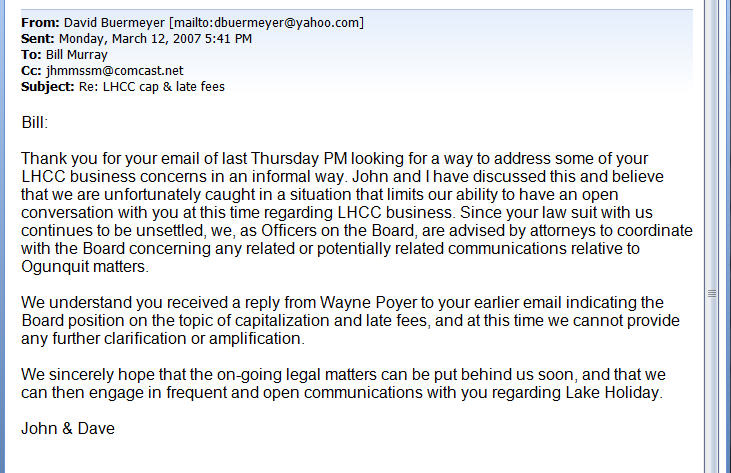
…caught in a situation that limits our ability to have an open conversation with you…

Buermeyer & Martel to Murray Email 3/12/07

Two months later, on video.

YouTube player
How informative did you find this post (1=lowest, 10=highest) ? Terrible2 Stars3 Stars4 StarsAverage6 Stars7 Stars8 Stars9 StarsTerrific!Loading...

Filed Under: Board Conduct Tagged With: Buermeyer, Martel

Quick Takes on the April 28th Board Meeting

May 4, 2008 By LakeHolidayNews

GM Ray Sohl and Secretary Ken Murphy
The April 28th was long – over 3 1/2 hours, not counting an executive session.

Review of a new front gate contract took about 5 1/2 minutes, but review of a $1500 reimbursement for additional lifeguard open water rescue training took over 30 minutes. The latter issue apparently stemmed from roving patrol/lifeguard supervisor Zeb Brevard, rather than the board, authorizing an expenditure made by the parent of one of the lifeguards.

Just because review of the front gate contract took 5 1/2 minutes doesn’t mean there was serious review. The board rubber-stamped GM Ray Sohl’s recommendation of keeping the contract with Haines at a cost of $15 per hour rather than accept a much lower cost proposal from Spartan at a cost of $13.33 per hour. The potential savings from Spartan’s proposal? About $15,000. The board couldn’t spend a lot of time on this $130,000 contract because it had to have enough time to discuss a contract with the lifeguards requiring them to reimburse the $100 training cost if they failed to work the entire season. At one point, presumably just to shorten a ridiculously long (or was it just ridiculous?) discussion, an audience member volunteered that he would reimburse the $100 training cost if that event occurred.

For the monthly staples, Martel gave the Treasurer’s Report and GM Ray Sohl gave the Management Report. Martel also put forward a motion to fully expense rather than capitalize all of LHCC’s depreciable assets. No director asked whether that was GAAP-compliant. For that matter, no director asked what GAAP is.

Dave Buermeyer gathered up some projections from Miller & Smith and some boxes of old documents. He rolled them into his Vision 10, a plan for the next 10 years at Lake Holiday. It drew applause from the board, which is the only group that will pay any attention whatsoever. Buermeyer also brought back more modifications to a policy to fill board vacancies. Secretary Ken Murphy secured approval for a new Rules Tracking System. At least they’ll look pretty. Early topic of the video: picking the right font. We’ll state the obvious: when a simple community association has to have a rules tracking system, it has too many rules. The board also approved a motion to hire a new collection agency, Debt Recovery Bureau, to try to collect old LHEUC debts on a contingency basis. According to Ray Sohl, these debts are outside the 3 year statute of limitations, and 1 firm has already tried a similar approach and given up after about 2 months.

On a positive note, director Steve Locke brought up negative communications relating to architectural compliance during the Committee & Task Force Reports. He was critical of his own experience and said the board needed to find a “much more neighborly way of going about things.” He thought “a little conversation would have gone a long way.” Perhaps his wife Deborah is working with him to try to develop a “kindler, gentler” side rather than the pseudo-tough guy tactics he displayed in our Keep It Over Here Punk video. Imagine: one LHCC director thinks “a little conversation” with an adversary could go “a long way.” Believable? Enduring? Let’s wait and see.

In earlier meetings, the board concluded that LHCC lacked the money to install guard rails, a safety issue, but evidently the money is there for the GM to solicit proposals to improve the acoustics at the clubhouse. Safety, no. Better acoustics for board members to hear themselves talk, yes.

The biggest topic of the night: re-financing the clubhouse loan. GM Ray Sohl started the discussion by stating that the “Board of directors has expressed an interest in re-collateralizing the existing clubhouse loan.” Oddly, there’s no expression of such interest during open meetings. Since the board voted on a motion to direct the GM to get bids on changes to the clubhouse acoustics, why is there no approved motion to direct the GM to investigate refinancing the clubhouse? This is just more evidence of the backroom discussions that Wayne Poyer denied the existence of when questioned by Bill Masters at the February Round Table.

In a sometimes heated debate, the board decided what to do about the fact that it pledged common assets without first obtaining 67% approval of the membership. To those who say the board never violates LHCC’s governing documents, this is just 1 example. The board acknowledged it didn’t follow LHCC’s governing documents on one of the largest transactions in Lake Holiday’s history. Jo-anne Barnard expressed the view that had she been given a chance to vote to incur a big mortgage to remodel the clubhouse, she would have chosen not to do so.

According to some board members, to fix things would require:

  • pledging over 90 LHCC-owned lots
  • paying $18,000 in closing costs
  • paying an extra $1400 per month for 5 years
  • putting a bank hold on $150,000-$200,000 of LHCC deposits for 5 years

The hold would prevent LHCC from using the money. The board’s fix relies on an artificial distinction between “common area” and “common property.” Mortgaging the clubhouse without member approval was wrong because the clubhouse is “common area,” but mortgaging 91 lots without member approval is acceptable because these lots, according to the board, are something entirely different – “common property.” The extended debate is covered in a total of 9 parts, the first 8 of which include the discussion and the last of which includes the final vote.

Several directors expressed the view that the fix was expensive at a time when money is tight and the damage from violating LHCC’s governing documents can’t be undone. The decision: put the issue to retroactively approve pledging common assets to a member vote (which will almost certainly fail, as Poyer himself acknowledged), and if it fails, to enter into the refinancing, probably in early 2009. Martel asked that the record reflect that this decision to refinance is a breach of directors’ fiduciary responsibility, and when Poyer objected to the minutes reflecting Martel’s comments, he withdrew them. Not to worry, John Martel. The record of your inability or unwillingness to stick to your position is amply reflected on YouTube.

We extend our continued thanks to Bill Masters for his unflinching efforts to let property owners monitor the conduct of LHCC’s board. Despite the board’s talk of openness, they blocked Masters’ videographer from the boardroom on the grounds that he wasn’t an LHCC member. Property owners should be deeply troubled by a board that blocks openness and at the same time denies it is doing such blocking.

How informative did you find this post (1=lowest, 10=highest) ? Terrible2 Stars3 Stars4 StarsAverage6 Stars7 Stars8 Stars9 StarsTerrific!Loading...

Filed Under: Board Conduct, Board Meeting, Finances Tagged With: Buermeyer, Haines, Jo-anne-Barnard, Locke, Martel, Masters, Miller-&-Smith, Murphy, Poyer, Ray-Sohl, Wachovia, Zeb-Brevard

Sidenote

May 3, 2008 By LakeHolidayNews

Are new Articles of Incorporation in your Vision 10, the ten year outlook for Lake Holiday? We’ve uploaded new videos from both the 5/15 special budget meeting and the 5/22 regular board meeting on our Videos page.

Filed Under: Sidenotes

  • Page 1
  • Page 2
  • Page 3
  • Go to Next Page »

Primary Sidebar

Recent Comments

  • Leona Garland on What You Weren’t Told About the Utility Sale
  • Leona Garland on LHCC Dues Are Too High By As Much As 46%
  • scott on LHCC Dues Are Too High By As Much As 46%
  • Eric on Jill Holtzman Vogel Rushes To Help Out Big Developer
  • Puzzled on Jill Holtzman Vogel and SB 1489: The Sequel To A Flop

Categories

General

  • Lake Holiday
  • Wikipedia Entry on Lake Holiday

Government

  • Virginia CIC Liason
  • Virginia Law
  • Virginia SCC Div of Energy Reg
  • Virginia SCC Docket Search

Other Builders

  • Lake Holiday, LLC

Other Voices

  • SchoolMatters.com Frederick Cnty
  • Summit Advisor Current News
  • Summit Advisor Forum

Copyright © 2005–2026 · WordPress · Log in